Spring is here and I love a relaxing nature game. Cascadia is a tile placement game where you are trying to place pieces to get the most points. This is extremely similar to Calico expect it’s a lot less rigid with how pieces are placed. Honestly I prefer Calico because I like that added difficulty but I also feel Cascadia will appeal to a much larger audience. It’s very intro friendly and easy to teach.
The Components are good, I love the token bag. For replay-ability you can switch up the scoring cards each time, other than that it stays pretty much the same. Like Calico, it has a solo mode and a lot different achievement goals to work towards. I really appreciate that, I enjoy solo modes but beating your own high score can get boring, adding the achievements is a small thing but it makes a difference.

Cascadia is published by Flatout Games and designed by Randy Flynn. It is a 1 to 4 player game that takes about 45 minutes to play.
Components
- 85 Habitat Tiles
- 5 Starter Habitat Tiles
- 21 Wildlife Scoring Tiles
- 100 Wildlife Tokens
- 25 Nature Tokens
- 1 Cloth Bag
Setup
Place wildlife tokens in the bag.
Randomly select Habitat Tiles based on the number of players.
- 2 players 43 tiles
- 3 players 63 tiles
- 4 players 83 tiles
Shuffle the tiles and place them facedown where everyone can reach.
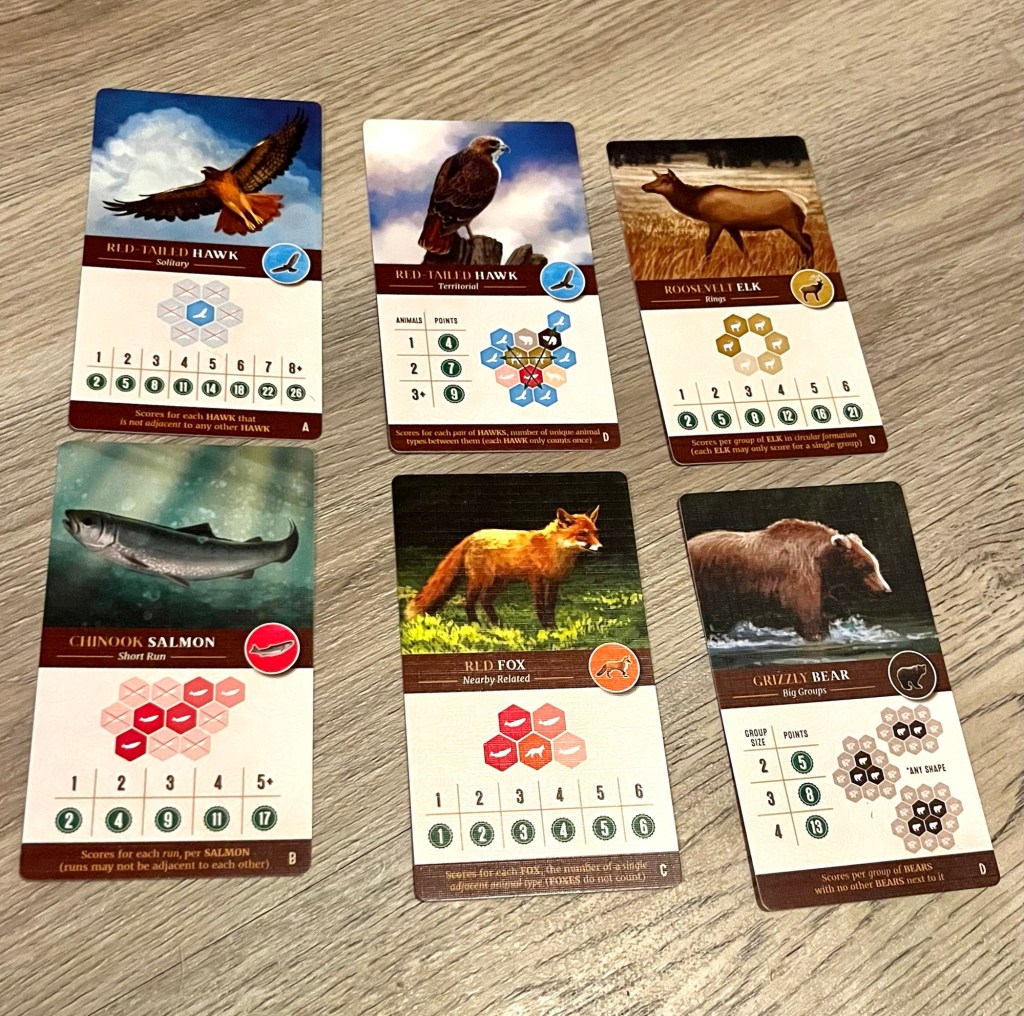
Select 1 Wildlife scoring card for each of the 5 different animal types. Place them on the table where everyone can see them.
Give each player a starter habitat tile, have them place it face up in front of them. This will be the start of their environment
Draw 4 Habitat tiles and and place them face up where all the players can reach. Then draw 4 Wildlife tokens and pair them with the habitat tiles. If all four wildlife tokens are ever the same, redraw all of them. If there are only 3 the same the active player can choose to redraw those.
Place the nature tokens where they can easily reached.
How to Play
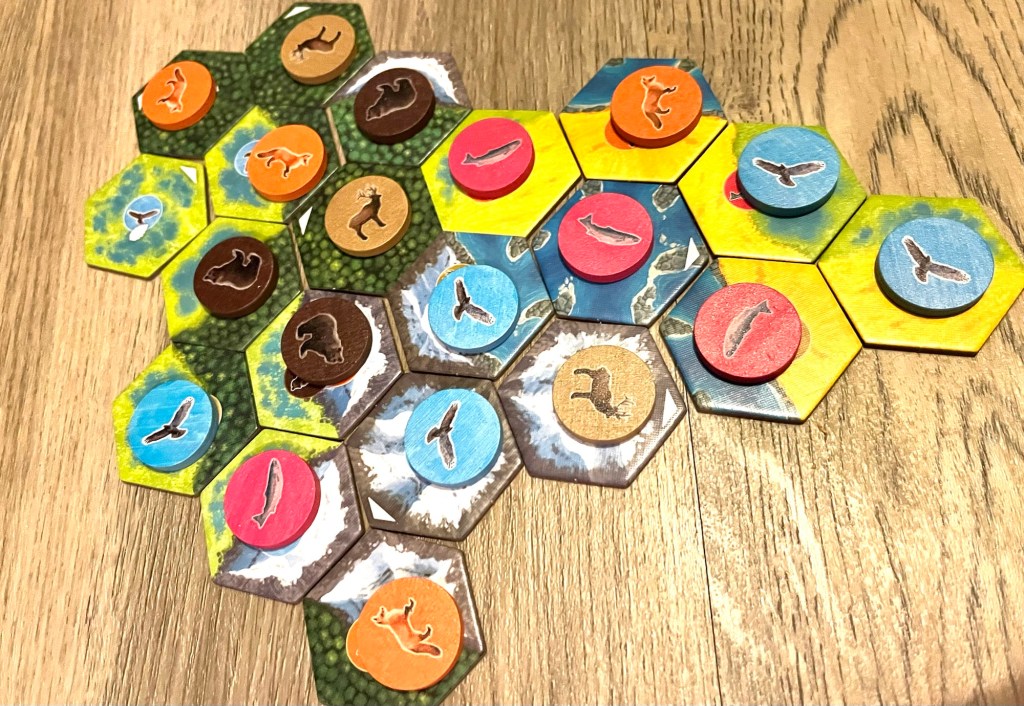
On a player’s turn they will select a habitat tile and the wildlife token it is paired with and play them in their environment. At the end of their turn, replace the habitat tile and wildlife token. The game ends when all the habitat tiles have been taken.
The Habitat tile must be placed adjacent to a tile already in your environment. It must touch at least one side.
The Wildlife token can be placed on a tile that has the matching animal symbol. There can only be one token on each tile. If you can’t place the token it will be returned to the bag.
If you place the token on a Keystone tile(with a leaf on it) you will receive a nature token.
On your next turn, before you choose your next tile you could play a nature token. A nature token will let you either take any one of the 4 habitat tiles and any one of the four wildlife tokens or wipe the wildlife tokens and draw new ones.
Once you’ve run out of tiles it will be time for end of game scoring.
- Wildlife Scoring Cards – the five cards chosen at the start of the game will show how to score the different types of wildlife tokens.
- Habitat Tiles – Players score 1 point per tile in their largest connected habitat type for each of the 5 habitats. Tiles must be connected by at least 1 side.
- Largest Habitats – Refer to the score pad, based on the number of players score points for the player who has the largest connected habitat type for each of the 5 habitats.
- Score 1 point for any unused Nature Tokens.
The Player with the highest score wins.
Cascadia has a classic feel to it, it is very straight forward and easy to pick up. If you like puzzles and arranging pieces it’s a great game to try.
If you like Cascadia try:
Overboss
 The Skillful Meeple
3 Comments Add yours