Periodic: A Game of the Elements combines set collection and science into a very unique learning experience.
Genius Games has this talent for taking science and making it engaging and fun. I would never look at the Periodic Table and think this would make a great game, but when you see it set up it just makes sense. This game looks sleek and clean. The pieces are great and again my favourite feature of Genius Games is the science behind the game booklet that is included. This is a really nicely packaged game. This game is fun anyone, but man I wish I had this available back when I was learning the periodic table.
The game itself is easy enough to pick up, I think you could teach it fairly quickly. The game feels a bit like a race, you have set collection and goal cards that will fill up fast. You are trying to move around the board in an efficient way spending energy to get the most points. Pair that with the Science theme and you have a really engaging educational experience.
Periodic: A Game of the Elements was designed by John Coveyou and Paul Salomon and published by Genius Games. It is a 2 to 5 player game ages 10 and up and takes about 45 minutes to an hour to play.
Contents
- 27 Goal Cards
- 8 Element Group Cards
- 15 Agenda Cards
- 11 Goal Cubes
- 38 Lab Tokens
- 35 Research Cubes
- 5 Flasks
- 10 Track Markers
- 12 Award Tiles
- 30 Energy Tokens
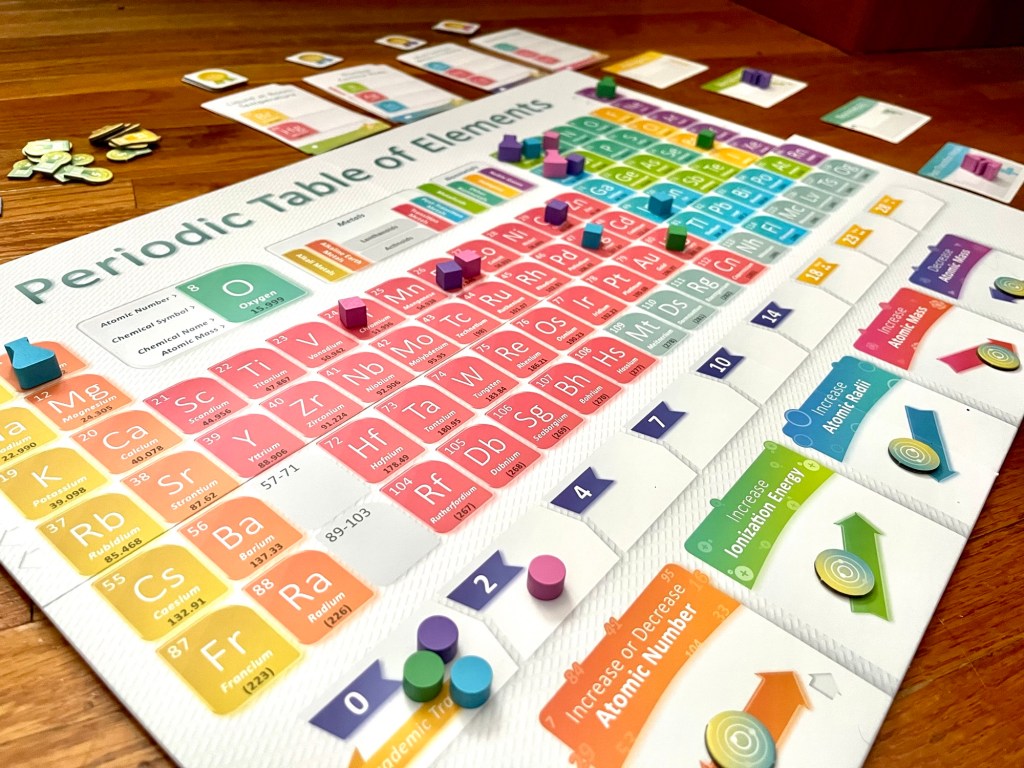
- 1 Periodic Table Game Board
Game Setup
Place the game board in the middle of the table.
Separate the Goal Cards by colour and shuffle each stack separately. Place a facedown stack for each color above the gameboard. Place the decks in the following order: green deck will have 6 cards, the blue deck will have 5 cards, the purple deck will have 5 cards, the pink deck will have 4 cards. Flip the top card of each deck faceup.

Place the three “+3 Spaces” Award Tiles above the green Goal Cards, the three “Take 2 Energy” Award Tiles above the blue Goal cards, the three “Free Action” Award Tiles above the purple Goal cards, and the three “Move To” Award Tiles above the pink Goal cards.
Place a green Goal Cube on each of the elements on the game board that match the elements on the green Goal Card. Do the same for blue, purple and pink.
Place the lab tokens into piles and place then next to the Goal Cards.
Shuffle the Element Group Cards and place four face up along the left side and four along the right side of the board.

Place an Energy Token on the Periodic trend spots on the bottom of the board.
Each player picks a colour and gets a flask, 2 Track Markers, and 7 Research Cubes.
The First player gets 3 Energy Tokens, the second player gets 4 energy tokens and the third player gets 5 Energy Tokens, the fourth player gets 4 Energy Tokens, and the 5th player gets 4 energy tokens. The fourth and fifth players will also move up on the Academic Achievement Track.
The first player places a track marker on the lowest Element Group Card on the left side of the board. The second player places their Track Marker on the third Element Group Card. The third player places their Track Marker on the 5th Element Group Card. The 4th player places their Track Marker on the 7th Element Group Card. The fifth player places their Track Marker on the second Element Group Card.
Each player then places their remaining Track Marker on the Academic Achievement Track. The first, second and third players place will be on the 0 spot and the fourth and fifth players will be on the 2 spot.
Deal each player 3 Agenda Cards, players will choose one and put the other two cards back in the box.
How to Play
Players will compete to discover elements and advance on the Academic Achievement Track. You will choose between spending energy or gaining energy. The game is played in turns which each turn having two main parts: Activating Periodic Trends and Refreshing After Your Turn.

1, Activating Periodic Trends
During this step you will move your Flask around the Periodic table and end your movement on the element you want to discover. Players move their Flask by activating periodic trends. There are five trend spots on the bottom of the board. When a periodic trend is activated, the player can move their Flask 1 to 5 spaces across the board from their starting position in the direction the periodic trend they activated allows. Trends are activated by spending energy tokens for multiple trends or by gaining energy tokens but only activating one trend.
a. Spend or gain energy tokens
Spend – pay Energy Tokens to activate multiple periodic
trends. To activate the first periodic trend, on your turn place 1 Energy Token on the periodic
trend you’d like to activate. Then move your Flask across the game board up to
5 spaces that the trend allows. Pay 2 Energy Tokens for additional trends you want to activate. You can activate as many trends as you’d like as long as you have energy tokens to pay for it.
Gain – collect all the Energy Tokens accumulated on a single Period Trend. The player can then move their Flask up to 5 spaced that the trend they collected from allows. This is the only trend they can activate on this turn. If there are no Energy tokens on the trend you’d like to activate, you may take 1 Energy Token from the player with the most Energy Tokens.
b. Move your Flask
After activating a trend you will move your Flask on the board from 1 to 5 spaces in the direction on the trend. More than one player can be on the same element.
The Five Periodic Trends – Movement Directions:
Atomic Number – allows a player to move their Flask EITHER left OR right. This is the only trend where you can jump from the right edge of the table to the left based on the Atomic Number.
Increase Ionization Energy – allows a player to move their Flask up and/or right.
Increase Atomic Radii – allows a player to move their Flask down and/or left.
Increase Atomic Mass – allows a player to move their Flask down and/or right.
Decrease Atomic Mass – allows a player to move their Flask up and/or left.
c. Discover Elements
Players earn point by discovering elements on the face up Goal Cards. Players can discover an element by ending movement on an element with a Goal Cube. Only 1 element can be discovered per trend they activate. When an element is discovered, the player will place a Research Cube on the Goal Card with that element. Elements can be discovered by multiple players on the Goal Card, but a player cannot discover an element on the same Goal Card twice.
If there are multiple Goal Cubes on an element on the board, a player
must choose one of the corresponding Goal Cards to place their Research Cube. They may come back and discover the other element on a future movement.
2. Refresh After Your Turn
When a player completes their movements, refresh the completed Goal Cards. If their Flask ends in the group of elements that corresponds to their next Element Group Card they move to the next
Element Group Card, and move up the Achievement Track.
a. Refresh Completed Goal Cards
Points are gained by discovering elements on the Goal Cards. Once a player has a Research cube on all the elements of a Goal Card, that card is complete. Lab Tokens go to each player with cubes on that Goal Card. Cubes are then returned to the players.
b. Assign Lab Tokens and Award Tile
Give Lab Tokens to all players with Research Cubes on completed Goal Cards:
● Players with 1 cube on the Goal Card take a 3 Lab Token
● Players with 2 cubes on theGoal Card take a 5 Lab Token
● The player who finished the card will take the Goal Card and the top Award Tile from the stack above the card instead of lab tokens.
Flip the next Goal Card over and place it on the stack. Move Goal Cubes onto the elements on the board based on the new Goal Card. It is the next player’s turn.
c. Advance Markers up Tracks.
Element Groups Track: Each of the eight groups of elements is represented on the track by an Element Group Card on the side of the board. Players move up the track at the end of their turn if their Flask is on any elements in an element group that corresponds to the next card on the track.
Academic Achievement Track
This track is on the bottom of the game board. This represents your position on the Element Group Track as well as the number of points award for advancing on the Elements Group Track.
When a player advances to the next Element Group Card, they also move one on the Academic Achievement Track. The last three spaces indicate the number of markers that can occupy the space.
Award Tiles
Players can use their gained Award Tiles during their turn to use its one time bonus. Once it has been used it goes back in the box.
Award Tiles include:
- 3+ Spaces: move up to 3 spaces
- Move To: Move to any element within the Element Group on the tile.
- Free Action: Take a free action
- Take 2 Energy: take two energy token but do not activate trends
Goal Cards
The Goal Cards show the elements that can be discovered. Goal Cubes are placed on the board for elements shown on the Goal cards. Points are awarded to players for discovered elements once the card is complete. Multiple players can discover elements on a goal card but once one player has discovered all the elements on the card, it is now complete. Players score points based on the amount of cubes they had on the card.
Agenda Cards
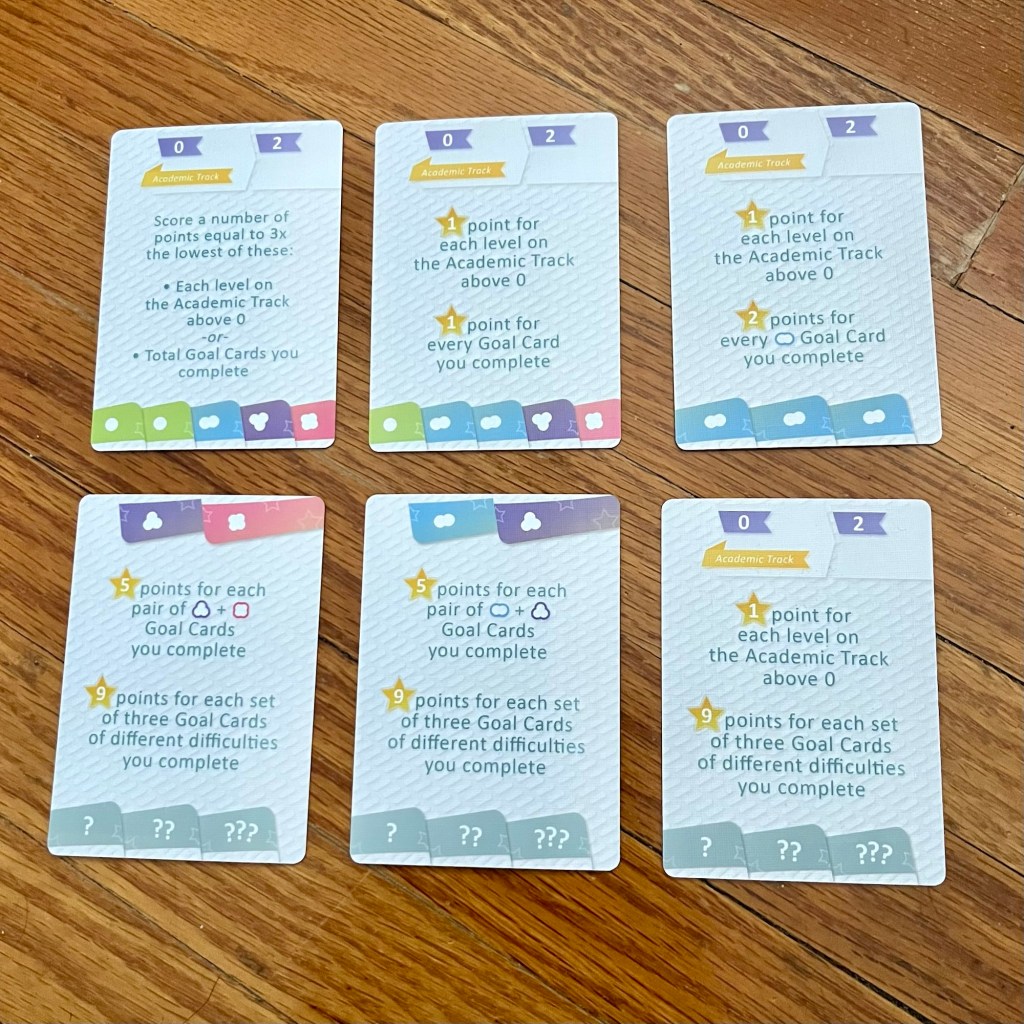
Agenda cards have the end of game objectives. A Goal Card only counts towards 1 objective on the Agenda Card.
End of Game
The final round is triggered if either one stack of Goal Cards is depleted or two players advance to the two right position on the Avademic Achievement Track. Once either of these happens each player gets a final turn then go to Final Scoring.
Final Scoring
Add up the following:
- Points from Goal Cards and Lab Tokens
- Points from the Academic Achievement Track
- Points from Research Cubes on incomplete Goal Cards
- Points from Agenda Cards
Tally up the score and the player with the most points wins!
Skillfulmeeple received a copy of Periodic: A Game of the Elements game from Genius Games to provide this review.
If you like Periodic: A Game of the Elements, try:
 The Skillful Meeple